
World CricketPakistan Clinch Tri-Series in Lahore: Fakhar Zaman's 127 off 99 Headlines Chase, Saad Baig Hits Maiden Fifty
Pakistan Clinch Tri-Series in Lahore: Fakhar Zaman's 127 off 99 Headlines Chase, Saad Baig Hits Maiden Fifty
पाकिस्तान ने लाहौर में श्रीलंका के खिलाफ त्रिकोणीय वनडे श्रृंखला का खिताब जीता। फखर जमान ने 99 गेंदों पर 127 रन बनाए (स्ट्राइक रेट 128.3; 11 चौके, 6 छक्के; कुल रनों का 63.0 प्रतिशत सीमा शॉट्स से) — यह उनका 12वां वनडे शतक था। साद बैग ने 75 गेंदों पर 74 रन की पारी खेली (स्ट्राइक रेट 98.7), जो उनका पहला वनडे अर्धशतक था। पाकिस्तान 36.5 ओवर में 230/5 पर था, जब दोनों सेट बल्लेबाज़ आउट हो चुके थे; टॉप तीन ने मिलकर केवल 5 रन बनाए (माज़ सदाक़त 5, बाबर आज़म 0)। लक्ष्य, जीत का अंतर, शेष गेंदें, टॉस, पिच रिपोर्ट और पाकिस्तान की गेंदबाज़ी के आंकड़े उपलब्ध स्रोत में नहीं हैं। सभी आंकड़े घरेलू (लाहौर) परिस्थितियों में बने हैं, इसलिए इन्हें घर से बाहर के आंकड़ों के साथ नहीं मिलाया जाना चाहिए।
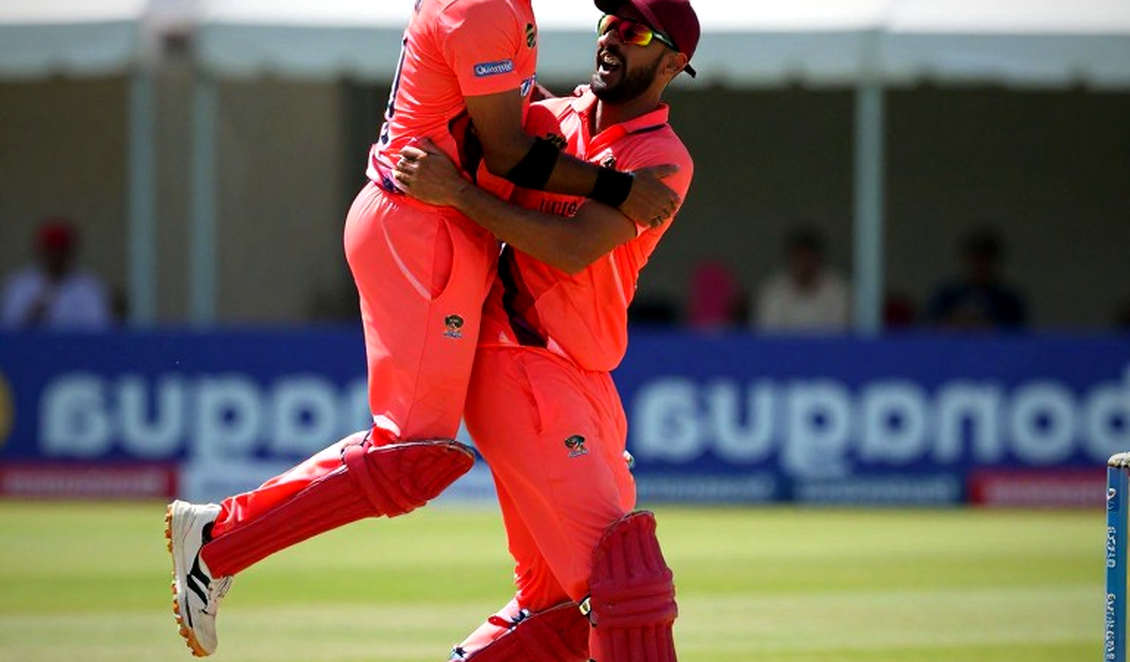
Pakistan secured the tri-series ODI title on home soil in Lahore with a chase built around Fakhar Zaman's 127 off 99 balls and a composed maiden fifty from Saad Baig — but the process data underneath the result tells a more complicated story than the headline does.
Fakhar's innings was the match's most verifiable data point. A strike rate of 128.3 sits well above the modern ODI top-order par of roughly 90 to 100, and he reached it from a position where his team had already lost two early wickets. Of his 127 runs, 80 came in boundaries — 11 fours and 6 sixes — which works out to a boundary share of 63.0 percent. His remaining 47 runs came off 82 balls, roughly 0.57 runs per ball. That is a boundary-or-dot profile rather than a rotation-heavy one: highly valuable in a high-required-rate chase, but structurally streak-dependent, because on a slower surface or against bowlers who take pace off, the same approach produces a lower floor.
The century itself is a longevity signal more than a peak signal. This was his 12th ODI hundred, which places him in a small group of Pakistani batters with sustained multi-year output in the format. It does not, on its own, establish that he is at his career peak.
Saad Baig's 74 off 75 is, structurally, the more informative innings. A maiden ODI fifty struck at roughly a run a ball, inside a rebuild, after early wickets, indicates temperament and format-appropriate tempo — the classic second-fiddle template in which a young batter holds an end while a senior partner attacks. But one innings, in home conditions, against bowling of unknown quality, establishes nothing about his ceiling against quality spin or away from home.
That is the point the result narrative tends to bury. Pakistan's top three contributed five runs between them: Maaz Sadaqat made 5 and Babar Azam made 0. A single duck is not a form verdict — it is a textbook small-sample trap and should be flagged, not concluded. But collectively, two of the top three contributing five runs means the batting unit was rescued rather than firing, and any framing that says the batting 'delivered on all fronts' is contradicted by the same article's own numbers.
The scoreline also carries a significant information gap. Pakistan were 230 for 5 after 36.5 overs, with 13.1 overs still available — but both set batters were already dismissed at that point. The available report stops there. The target, the margin of victory, the balls remaining, Pakistan's bowling figures and Sri Lanka's innings are all absent. The word 'daunting' attached to the total is the author's framing, not a number. A reader relying only on the body of the report cannot reconstruct how the chase actually finished, which means any claim that this was a dominant win rests on the headline rather than on data.
Context matters here too. Every data point in this match was produced in Lahore, at Pakistan's home venue, in front of a home crowd. Lahore surfaces have historically favoured batting, though no pitch report is available and that remains an inference rather than a fact. The practical implication is unambiguous: these figures are home-condition figures and should never be merged with away ODI splits, because conditions, bowling quality and pressure all change when a team travels.
On the team picture, the match paints a two-track portrait. Pakistan simultaneously extracted a match-winning innings from an experienced campaigner and meaningful ODI minutes from at least two younger or less-established players. That is a healthy transition pattern — but only if those players are being given a defined role rather than being used as injury cover, and the available material does not distinguish between the two. Batting depth appears exposed at the top and resilient in the middle. The bowling combination, bench depth and age structure cannot be assessed, because no bowling data appears anywhere in the source material. No conclusion about Pakistan's standing in ODI cricket is supportable from a single home result.
Commercially, the meaningful signal is hosting capacity, not player economics. This is an international tri-series, not a franchise league: there is no auction, no retention, no salary-cap signalling, and importing T20 league logic into an international title is a category error. Pakistan staging and winning a multi-nation ODI series at home is the asset, because home international cricket is what unlocks broadcast inventory, ticketing and sponsorship. No figures for any of those exist in the source material, so no quantitative commercial assessment is possible.
On governance and rules, the article contains no controversy whatsoever — no DRS dispute, no DLS target revision, no over-rate sanction, no code-of-conduct charge. That is worth noting as a clean baseline. The governance significance here is hosting-related rather than rules-related: a Sri Lanka tour of Pakistan in Lahore is itself an administrative and security achievement given the long interruption of international cricket in the country after 2026. The cap and eligibility status of the younger players cannot be established, and treating them as debutants would be an assumption rather than a finding.
Overall risk is medium, and the rating is driven almost entirely by the sporting dimension. The primary risk is top-order dependency concealed by a single match-winning innings. The secondary risks are small-sample over-promotion of Saad Baig, home-condition inflation of every performance number in the report, age-curve exposure on the senior batting core, and a narrative risk: the headline says 'clinch' while the body stops at 230 for 5, and if that framing is absorbed uncritically, Pakistan's batting fragility gets priced out of the picture entirely.
The signals worth tracking are straightforward. Pakistan's top-three aggregate across the next five ODIs, with a trigger at roughly 60 percent of team runs. Saad Baig's away and against-spin splits, with a trigger at a strike rate below roughly 75 away from home. Fakhar Zaman's boundary share by pitch type, with a trigger below roughly 45 percent without a matching rotation uplift. Pakistan's bowling-unit performance, which is entirely absent from this source. And the status of the match itself — final or league fixture — because that determines whether the selection inferences drawn here hold.
Core judgment: the trophy is real; the 'batting delivered on all fronts' framing is not supported by the article's own numbers. This report is based on public information and available match material, is provided for sports-information and analytical reference only, and does not constitute betting advice or prediction. Several conclusions above are explicitly constrained by incomplete information and should be re-tested once a full scorecard is available.

संबंधित खिलाड़ी
लोकप्रिय/पसंदीदा पुस्तकें
The Cricket Data Ledger: When Empty Pipelines Threaten Analytical Integrity2026-11-02
Fakhar Zaman's 127 and Saad Baig's Maiden Fifty Seal Tri-Series for Pakistan in Lahore2026-11-02
The Document That Came Back Empty: Building a Reliability Filter in a Transfer Window2026-11-01
Zero and Blank Are Not the Same: Why Cricket Data's Silence Must Never Be Read as 'No Problem'2026-11-01
Fakhar Zaman's 127 Is the Headline, Not the Ledger: Pakistan's 326 Chase Was Built on Three Dropped Catches and a 94-Run Stand2026-11-01
अनुशंसित
The Empty Dossier: When a Cricket Report Had No Match to Write About2026-10-25
Thirty Points, Twenty-Eight Points and an Unsigned Contract: The Ledger Behind Roston Chase's Briefing That Does Not Reconcile2026-10-28
Rain in Kandy, Dust in Dambulla: Why England's 2027 Sri Lanka Tour Arrives in Two Pieces2026-10-30
The Real Story of 213/3 at Mirpur: Shadman's 99*, West Indies' New-Ball Plan and the Arithmetic of the 80th Over2026-10-29
The Empty Frame: When Cricket's News Pipeline Returns Nothing2026-11-01
अनुशंसित
A Lahore Win, Not a Batting Win: Fakhar's Century Masks Pakistan's Top-Order Crisis2026-11-01
Cummins' Dilemma and the Cape Town Call: Australia's Real Test Is Batting Balance2026-10-24
From 5/4 to 221/7: Omarzai's Blitz and Rashid's 200th Wicket Help Afghanistan Seal Series 2-02026-10-31
Chasing 326 With Three Reprieves: Pakistan's Win Is Four Ledgers, Not One Hero2026-11-01
Zero Information Points, Eight Sections: The Cricket Report That Should Never Have Been Filed2026-10-24