
Fakhar Zaman's 127 and Saad Baig's Maiden Fifty Seal Tri-Series for Pakistan in Lahore
**संक्षिप्त उत्तर:** पाकिस्तान ने लाहौर में श्रीलंका के खिलाफ त्रिकोणीय वनडे सीरीज़ का खिताब जीता। फखर ज़मान ने 99 गेंदों पर 127 रन बनाए (स्ट्राइक रेट 128.3, 11 चौके, 6 छक्के) जो उनका 12वां वनडे शतक है। साद बैग ने 75 गेंदों पर 74 रन बनाकर पहला वनडे अर्धशतक पूरा किया। पाकिस्तान 36.5 ओवर में 5 विकेट पर 230 रन पर था, तब दोनों सेट बल्लेबाज़ आउट हो चुके थे। **मुख्य आंकड़े:** फखर का बाउंड्री शेयर लगभग 63 प्रतिशत (80/127); साद बैग का स्ट्राइक रेट लगभग 98.7; टॉप तीन का कुल योगदान केवल 5 रन (माज़ सदाक़त 5, बाबर आज़म 0)। **क्यों महत्वपूर्ण:** घरेलू धरती पर बहुराष्ट्रीय सीरीज़ का आयोजन और जीत पाकिस्तान की मेज़बानी क्षमता को मज़बूत करती है। साथ ही दो कम अनुभवी खिलाड़ियों को वनडे अनुभव मिला। **सावधानी:** लक्ष्य, जीत का अंतर, बाकी गेंदें, टॉस, मौसम, पिच रिपोर्ट, पाकिस्तान की गेंदबाज़ी के आंकड़े और श्रीलंका की पारी की जानकारी उपलब्ध नहीं है। यह भी स्पष्ट नहीं है कि यह मुकाबला फाइनल था या लीग का निर्णायक मैच। 'बल्लेबाज़ी हर मोर्चे पर चली' का दावा टॉप-ऑर्डर के 5 रनों के आंकड़े से टकराता है। सभी आंकड़े लाहौर की घरेलू परिस्थितियों में बने हैं, इसलिए इन्हें बाहर के आंकड़ों के साथ नहीं मिलाया जाना चाहिए। यह विश्लेषण किसी सट्टेबाज़ी सलाह या भविष्यवाणी के रूप में नहीं है।
Pakistan have claimed the home ODI tri-series title in Lahore, built almost entirely on a 127-run innings off 99 balls from left-handed opener Fakhar Zaman — his 12th ODI century. Young batter Saad Baig made 74 off 75, his maiden ODI half-century, holding the innings together after early wickets. According to the available details, Pakistan were 230 for 5 after 36.5 overs, meaning 13.1 overs remained and both set batters had already been dismissed.
Early collapse and the value of the stand
The clearest thread in this innings is top-order failure. Maaz Sadaqat made 5 and Babar Azam was dismissed for 0 — two of the top three contributing five runs between them. Fakhar and Baig's partnership did not merely stop the slide; it pushed the score toward what the report describes as a daunting total. Crucially, that stand was built after the collapse, not on the foundation of a functioning top order.
Fakhar Zaman: 128.3 strike rate and boundary dependence
Fakhar's most significant number is his strike rate of 128.3. Modern ODI top-order par sits roughly at 90 to 100; anything above 120 is elite-aggressive. His 127 included 11 fours and 6 sixes, meaning 80 runs came in boundaries — about 63 percent of his total, above the typical top-order norm. He faced 17 boundary balls in 99 deliveries, roughly 17.2 percent, indicating aggressive intent throughout rather than a late surge.
There are two sides to this. With the other opener on 5 and the number three on 0, a hundred at 128 strike rate is almost certainly match-defining rather than supporting. But the profile is boundary-or-dot: outside boundaries he made 47 runs off 82 balls, about 0.57 runs per ball. That is highly valuable in a chase with a high required rate, but it is streak-dependent. On a slower surface, or against bowlers who take pace off, the same approach produces a lower floor. It is also worth noting that a 12th ODI hundred is a longevity signal, not proof of peak.
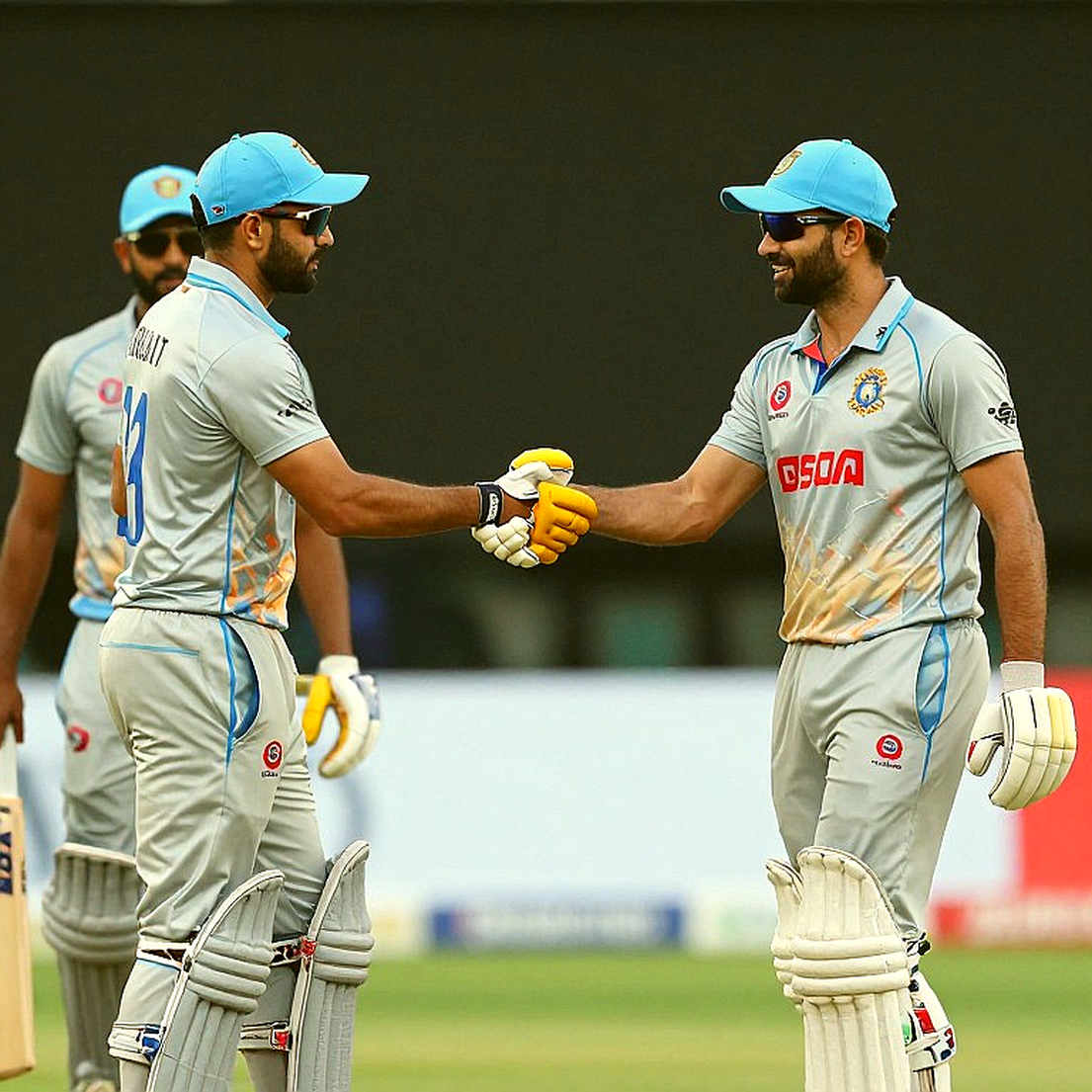
Saad Baig: the structurally more informative innings
74 off 75 works out to a strike rate of about 98.7. A maiden ODI fifty at roughly a run a ball, inside a rebuild, indicates temperament and format-appropriate tempo — the classic second-fiddle template that does not waste deliveries. But this is one innings, in home conditions, against bowling of unverified quality. Establishing his ceiling on this basis would be premature.
Babar's duck and the framing contradiction
Babar Azam's zero is not a form verdict; it is a textbook small-sample trap and no conclusion should be drawn from it. More important is the claim that Pakistan's batting delivered on all fronts — a claim contradicted by the same report's numbers, where two of the top three made five runs. This is exactly the kind of media framing that should not be carried into any assessment of Pakistan's batting reliability.
Team structure: rescued, not balanced
A host side needing a 128-strike-rate hundred and a maiden fifty to cover five runs from its top three is showing structural dependency, not a balanced batting unit. The generational picture is two-track: a match-winning innings from an experienced campaigner alongside meaningful ODI time for less-established players. That is a healthy transition pattern only if the younger players are being given defined roles rather than used as injury cover, which the report does not establish. Bowling combination, bench depth and Pakistan's bowling figures are entirely absent from the available information.
Home conditions
The entire match was played in Lahore in front of a home crowd. Lahore surfaces have historically favoured batting, though no pitch information is given for this game. Every data point here therefore carries home advantage and should not be merged with away splits.
Hosting as the strategic asset
The commercially meaningful signal is hosting capacity, not player economics. Pakistan staging and winning a multi-nation ODI series on home soil is the asset, because home international cricket is what unlocks broadcast inventory, ticketing and sponsorship. Importing franchise-league logic into this result is a common error: a tri-series title carries no auction value and no salary-cap signalling. Broadcast, sponsorship and attendance figures are unavailable.
Risk picture
The largest sporting risk is that the win rests on one exceptional innings and one maiden fifty, sitting on top of a top-order collapse. The second is small-sample overreaction to Baig's 74. The third is home-condition inflation of every data point. The fourth is age-curve exposure on the senior core, which argues for succession planning in the opener slot. The public-opinion risk is the headline-body mismatch: the headline asserts a clinching while the body stops at 230 for 5, creating a dominant-win impression the data does not support. Overall risk is medium, driven almost entirely by the sporting dimension.
Narrative versus expectation
The current story is home fortress plus veteran delivers plus new star emerges. On Fakhar it is directionally fair: 127 off 99 and a 12th hundred are verified. On the batting unit it is overstated. Sustained hype around Baig requires away and quality-spin samples; historical conversion from one home fifty to durable international output is low. No hype-backlash cycle is visible yet; the narrative is at acceleration, not climax.
What is missing
Target, victory margin, balls remaining, toss, weather, dew, pitch report, Pakistan's bowling figures and Sri Lanka's innings are all absent. The match date and its status within the series are also unclear. Whether the chase was comfortable or tight cannot be assessed. The phrase daunting total is the author's framing, not a number.
What to track
Pakistan's top-three aggregate across the next five ODIs: below roughly 60 percent of team runs confirms structural fragility. Baig's away splits: a strike rate under roughly 75 away reclassifies him as a home-condition beneficiary. Fakhar's boundary share on slower surfaces: below roughly 45 percent without a rotation uplift signals surface dependency. Pakistan's bowling-unit performance, absent here, should be tracked separately.
Conclusion
The trophy is real. The process data says the batting was rescued, not that it fired. A 128.3 strike rate hundred and a maiden fifty are genuine signals; five runs from the top three and an incomplete scorecard keep this result within-context performance evidence only.