
Commonwealth Kabaddi Championship 2026: Everything Is Ready in Ahmedabad — Except the One Question That Matters Most
कॉमनवेल्थ कबड्डी चैंपियनशिप 2026: 23–31 अक्टूबर, वीर सावरकर स्पोर्ट्स कॉम्प्लेक्स, अहमदाबाद। यह पहला संस्करण है, जिसमें 13 देश भाग ले रहे हैं (पाकिस्तान ने नाम वापस लिया)। पुरुष और महिला दोनों वर्ग होंगे। भारत दोनों वर्गों में प्रबल दावेदार है; मुख्य चुनौती ईरान से, खासकर महिला वर्ग में। आधिकारिक प्रसारक/ओटीटी प्लेटफॉर्म की घोषणा नहीं हुई है, इसलिए "भारत में मुफ़्त कहां देखें" का कोई पुष्ट उत्तर नहीं; मुफ़्त स्ट्रीमिंग की संभावना अधिक है। टूर्नामेंट प्रारूप आधिकारिक रूप से घोषित नहीं, लेकिन 9 दिनों में 13 टीमों के लिए दो पूल + नॉकआउट ही व्यावहारिक है। मंज़ूरी देने वाला निकाय सार्वजनिक नहीं। आयोजन का मुख्य उद्देश्य अहमदाबाद में 2030 कॉमनवेल्थ गेम्स के खेल कार्यक्रम में कबड्डी को शामिल कराने की पैरवी है।
The first Commonwealth Kabaddi Championship will be played at the Veer Savarkar Sports Complex in Ahmedabad from 23 to 31 October. Nine days, 13 nations, separate men's and women's competitions, and a host country that has spent the last decade in possession of nearly every major international kabaddi trophy. On paper, this is a landmark moment in the Indian kabaddi calendar. On the ground, it is an event with no publicly confirmed broadcaster, no named sanctioning body, no published draw and no squad lists. That contradiction is the real story of this Championship.
Thirteen teams, nine days — and one missing detail
According to the organisers, 13 countries are taking part after Pakistan's withdrawal. The tournament format has not been officially announced, but the arithmetic is straightforward: a full 13-team round robin would require roughly 78 matches, which is impossible in nine days. The practical structure is therefore almost certainly two pools followed by semi-finals and a final. That means several teams may have to play twice in a single day, and that is where the tournament's real technical question begins — not the quality of the starting seven, but the depth of the bench.
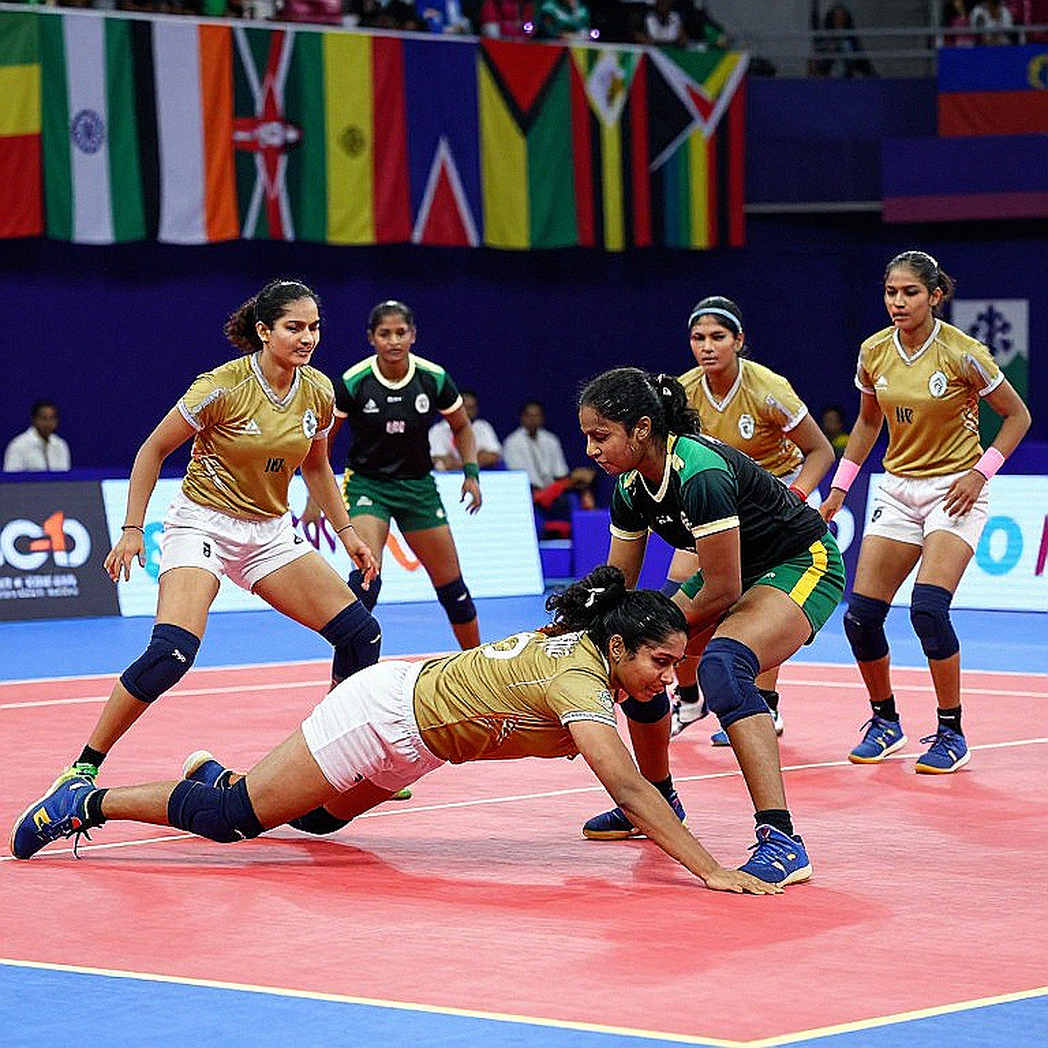
This is a structural advantage for India. Where smaller nations will field state-level or semi-professional replacements, India's eighth-to-fourteenth best players would walk into most of the participating squads. But the same fact caps the event's sporting value: the level of competition is uneven, and numbers piled up against weaker teams will look very different against Asian Games or Pro Kabaddi League opposition.
Whose rulebook?
Kabaddi has two main variants — Standard Style (the 13m × 10m rectangle used at the Asian Games and in the PKL) and Circle Style, which is popular in rural Punjab and among diaspora communities. Standard Style is expected here, but the event's official communications have not clarified which rulebook governs the matches: the International Kabaddi Federation's, an AKFI variant, or a Commonwealth-specific adaptation.
This is not pedantry. Multi-nation events with mixed officiating standards are historically where disputed calls, walkovers and appeal controversies originate. The on-mat rules that will draw attention are technically clear: a raider has 30 seconds and must chant the cant continuously while returning to his own half; one point per successful touch or tackle; one point for crossing the bonus line; two for a super tackle with three or fewer defenders; and two points plus a full team revival when the opposition is all out. The do-or-die raid — compulsory scoring after two empty raids, with the raider himself ruled out on failure — is the sport's built-in anti-stalling mechanism.
In a compressed multi-match tournament these rules favour India. The bonus line rewards deep, aggressive raiding, and India's raiders are the best in that category. But the real risk is not in the rulebook; it is in control. With the host nation also being the strongest team, any disputed decision will attract scrutiny, and the organisers have said nothing about match official appointments or a review mechanism.
India are favourites in both categories — but not equally
India are being described as strong favourites in both the men's and women's draws, and in the men's competition that claim is sound. Treating both in a single sentence, however, flattens a real asymmetry. The women's field is thinner overall, but at the top it is sharper: Iran's women have been the most consistent structural challenge to India in Asian kabaddi for over a decade. In the men's game the gap between India and Iran has widened in recent years; in the women's game it is considerably narrower.
This matters because women's kabaddi has no equivalent of the Pro Kabaddi League. For male players, the PKL provides both livelihood and visibility; for female players, multi-nation events like this one are the primary stage. By that measure, Ahmedabad's women's tournament is more important to the sport's development than the men's, even if it receives less coverage.
Pakistan's withdrawal: the least-reported link
Pakistan's withdrawal is the least-discussed and most consequential fact about this event. No reason has been made public. An administrative, political or clearance-related cause is more plausible than a form-based one — national teams do not normally pull out of an event of this tier on performance grounds.
The effect is twofold. First, India's favourite status is mechanically reinforced, because the one opponent with a deep Circle Style tradition and a strong kabaddi culture has left the field. Second, the tournament's emotional and commercial pull is reduced — kabaddi is one of the few sports where an India–Pakistan fixture carries a cricket-like charge. Losing that fixture weakens the event as a product, even if it improves India's chances.
Why Ahmedabad, not Haryana or Punjab?
India's kabaddi heartland is Haryana, Punjab, Maharashtra, Uttar Pradesh and Tamil Nadu. Gujarat is not part of that belt. The host city choice matters because Ahmedabad is the designated host city for the 2030 Commonwealth Games. This Championship is therefore not designed to showcase an existing market but to build a new one, and a facility narrative alongside it.
Put plainly, this is a dry run — a proof of capability for the CWG 2030 organising apparatus, and a live argument for adding kabaddi to the Games programme. Bids to enter the Olympics have repeatedly failed; the Commonwealth route, particularly with India as host, is far more plausible. But it also means the event's success criteria are political rather than sporting. That does not make it worthless; it makes it a political event whose competitive integrity is not the primary design objective.
Thirteen participating nations out of the Commonwealth's 56 members is itself an honest number. It is the real measure of kabaddi's global footprint, not evidence of the grandeur implied by the word "Commonwealth".
"Where to watch for free?" — the unanswered question
This is the biggest and most overlooked problem with the entire event. None of the pre-event material available names any official broadcaster, channel or OTT platform. There is also a headline promising a "list of all teams" with no list beneath it.
For any pre-event utility report, this is a serious failure: the article does not answer its own core question. Only two conclusions are possible. Either the broadcast arrangements genuinely were not finalised at the time of writing, which is a symptom of the event's commercial immaturity; or the information existed but did not reach the publisher, which reduces the article's informational value to zero. Either way the inference is the same: this event's broadcast distribution is not yet a settled commercial product.
The "free in India" framing is itself a signal. A paid sports channel or subscription platform requires proven demand, which a first edition cannot yet demonstrate. Free distribution buys reach and builds the CWG 2030 case. The most likely scenario is that matches will be streamed free on a federation or organiser YouTube channel, or via a public broadcaster — but that is inference, not confirmation. The practical advice for viewers is simply this: wait for an official announcement before the event, and do not trust unauthorised streaming links.
The governance gap
Which body has sanctioned the event — the IKF, a Commonwealth kabaddi organisation, the AKFI, or a state authority — is unclear. With the host nation also being the strongest team, a conflict of interest is inherent, and no explicit officiating safeguards have been declared. Nor is there any public information on a doping-testing framework, athlete registration and cross-border clearance procedures, or an appeal and review mechanism. None of this is unusual for a new multi-nation event, but when the event's primary purpose is to secure entry into a larger tournament, the lack of transparency does the most damage.
Commercially, the real money in this event is not in media rights but in host-city and CWG 2030 infrastructure investment. Ticketing, sponsorship and prize money have all gone undisclosed.
So what should you actually watch?
Not the results. An Indian men's title is expected and should not be read as an achievement. The women's competition is likely to be closer, and that final may be the most competitive match of the tournament. The genuinely useful information will be who India plays — which new faces get opportunities, who is rested, and what the rotation reveals about the pipeline for the next cycle. With the Asian Championship and World Cup cycle coming up, that is the real output.
And one warning: discount this event's individual statistics heavily. Inflated tackle and raid totals against low-tier opposition do not transfer to the next level — that is the oldest and most common trap in kabaddi analysis.
In the end, the significance of the Commonwealth Kabaddi Championship 2026 lies not in who wins it, but in what it can prove by its second edition. If, by then, there is a named broadcaster, a clearly identified sanctioning body, a published draw and photographs of a full stadium, the project will have succeeded. If all that remains is a list of 13 countries and an empty heading, it will not have.