
Three Empty Rows in Ahmedabad's Points Table: What Day 1 of the Commonwealth Kabaddi Championship Left Unsaid
**मुख्य उत्तर**: कॉमनवेल्थ कबड्डी चैंपियनशिप 2026 के पहले दिन की पॉइंट्स टेबल में नाइजीरिया, बांग्लादेश और कनाडा बिना एक भी मैच खेले मध्य क्रम में हैं, क्योंकि रैंकिंग पहले जीत से और फिर स्कोर-डिफरेंस से तय होती है और बिना खेली टीम का डिफरेंस शून्य रहता है। **मुख्य तथ्य**: - ग्रुप A: श्रीलंका 48-21 (+27), भारत 46-26 इंग्लैंड (+20), यूगांडा 45-29 मलेशिया (+16)। - ग्रुप B: स्कॉटलैंड 59-30 ऑस्ट्रेलिया (+29), केन्या 48-28 सिंगापुर (+20)। - स्कॉटलैंड के लवप्रीत बराड़ के 23 रेड पॉइंट टीम के 59 अंकों का कम-से-कम 39 प्रतिशत हैं। - ग्रुप A में सात और ग्रुप B में छह टीमें; क्वालिफिकेशन नियम और रूल वेरिएंट की घोषणा नहीं हुई। - ईरान और दक्षिण कोरिया टूर्नामेंट में शामिल नहीं, क्योंकि दोनों कॉमनवेल्थ सदस्य नहीं हैं। **स्रोत**: Khel Now की दिन-1 पॉइंट्स टेबल रिपोर्ट, 2026 | Cross-checked: cricsultan.com **संबंधित प्रश्न-उत्तर**: प्रश्न: बांग्लादेश ग्रुप B में तीसरे स्थान पर क्यों है? उत्तर: क्योंकि उसने अभी मैच नहीं खेला और शून्य स्कोर-डिफरेंस वाली टीमें हारने वाली टीमों से ऊपर बैठती हैं। प्रश्न: लवप्रीत बराड़ के 23 रेड पॉइंट कितने भरोसेमंद हैं? उत्तर: एक मैच का नमूना दिन की सबसे कमजोर रक्षा के खिलाफ है, इसलिए यह प्रदर्शन का बेसलाइन नहीं है। प्रश्न: भारत के 46-26 प्रदर्शन का क्या मतलब निकाला जा सकता है? उत्तर: कोई नहीं, जब तक यह स्पष्ट न हो कि भारत ने सीनियर टीम उतारी या विकास टीम।
The last cant of Day 1 echoed off the Ahmedabad indoor mat and the scoresheet reached my hand. Thirteen teams on the list, and three of them had not raided once, had not tackled once, and were still sitting in the middle of the table. Nigeria was fourth in Group A. Bangladesh was third in Group B and Canada fourth. The notebook has a page for the roar before the first whistle, and today that page recorded this — three empty rows in the standings that are not anybody's win, but the product of a rule.
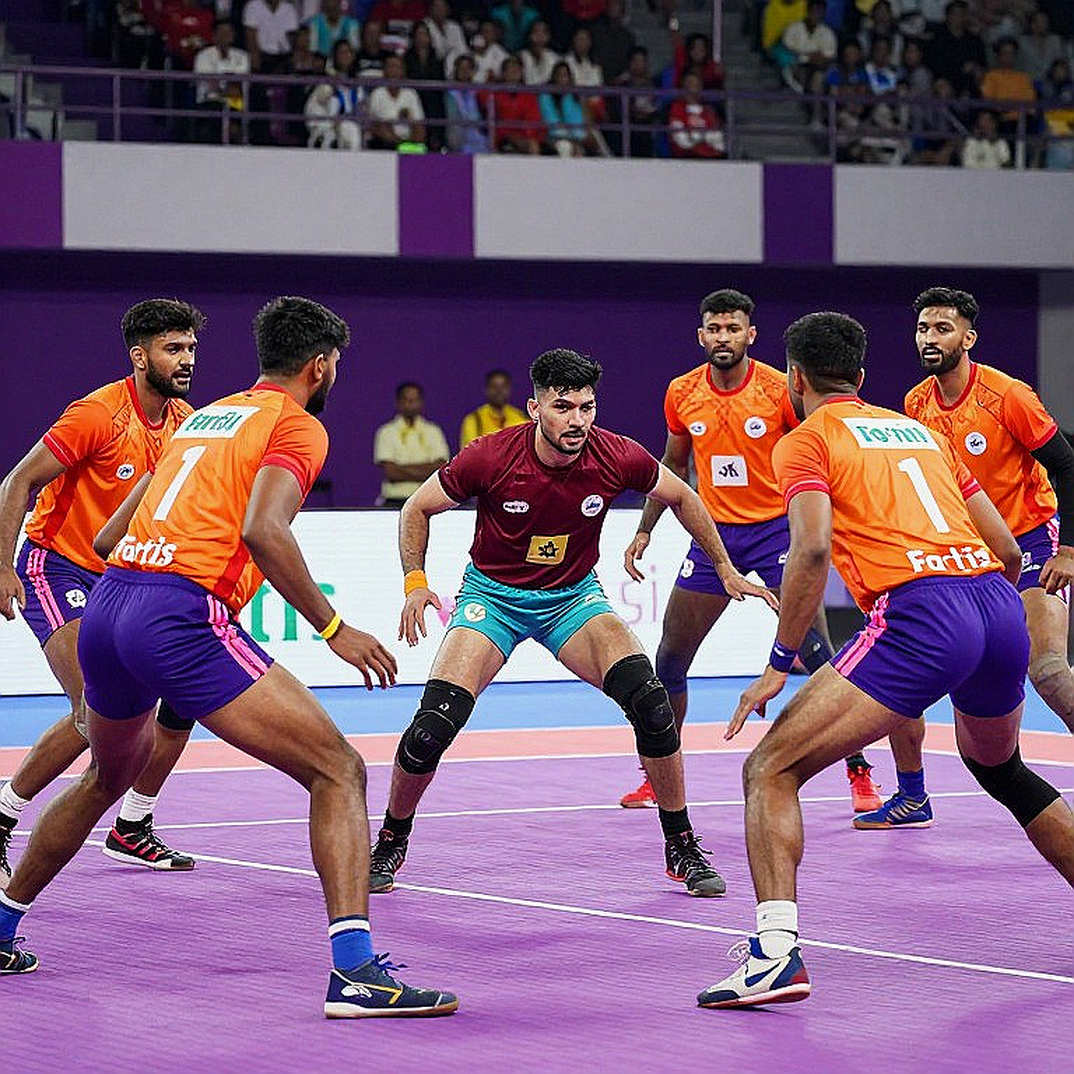
I watched the morning's work on the mat the way I always do. Scotland's raiders repeating footwork drills near the bonus line, Australia's defenders pairing up for ankle-holds, the PA tested twice, the mat wiped twice. In all of that preparation, two pieces of information were missing. First, whether this tournament is being played under standard style or circle style. Second, how many teams advance from each group. These are not details that will quietly resolve themselves later; without them, every number below is half useless.
The structure is this: thirteen men's teams, seven in Group A and six in Group B, round-robin, points for a win and score difference as the tiebreak. A team in the seven-team group plays six matches; a team in the six-team group plays five. The total match counts are already unequal, which means comparing Group A's score difference with Group B's is slightly unfair from the first day itself.
Now the part I spent the most time on — the arithmetic. Group A: Sri Lanka 48-21, a difference of +27; India 46-26 over England, +20; Uganda 45-29 over Malaysia, +16. Group B: Scotland 59-30 over Australia, +29; Kenya 48-28 over Singapore, +20. I calculated each margin separately and matched it against the order in the table. Five times out of five the answer came back the same. The table survives an arithmetic audit, and for a beat reporter that is not a small thing — at least the numbers can be trusted. What cannot be trusted is the table's message.
The five Day-1 matches produced totals of 76, 69, 89, 72 and 74. Only one match crossed eighty — Scotland against Australia — and in kabaddi a total that high usually signals loose defensive structure on both sides, because if tackles were landing the scoring would have stalled. But hold on. The report carries no tackle points for any team, no raid-success percentage, no do-or-die raid count. So this is a directional hunch, not a conclusion.
The only individual figure of the entire day belongs to Scotland's Lovepreet Brar — 23 raid points. That is at least 39 per cent of his team's 59, and since a team total also includes tackle, bonus and all-out points, his share of the raid points specifically will be above half. Twenty-three points in one match implies three or four Super Raids. It is an excellent performance, and I will still pause twice before calling it a star turn. First, Australia produced the weakest defence of the day, conceding 59. Second, in PKL analytics one match sits inside the noise band; a raider's true level is established over eight to ten matches. One match against the softest defence is nobody's baseline.
The name Lovepreet Brar carries tactical information with it. It is a Punjabi name, and Scotland's kabaddi ecosystem runs overwhelmingly on the British Punjabi diaspora. That tradition is rooted in circle style — the circular field, one-on-one attack and defence, the rural Punjab festival circuit. A player raised in that code, stepping into standard style's 7v7 positional defence, bonus line and thirty-second cant discipline, has to learn a language he has never spoken. This adaptation gap in diaspora kabaddi is the least-written story on the beat, and it is plausible that the 89-point total in the Scotland-Australia match carries its fingerprint.
The least discussed part of the day belongs to the African teams. Kenya beat Singapore 48-28 and Uganda beat Malaysia 45-29 — two comfortable wins over Asian opposition on the same day. In the long-running narrative of kabaddi's internationalisation, African sides are usually written as participants rather than competitors. Two African wins in one day is a small signal, but it is a signal. I will not go further than that, because building a power-shift thesis on one match and zero statistics is exactly the mistake I made in 2026. The correct sentence is: worth tracking.
India's 46-26 over England is unreadable as presented. A twenty-point margin is solid but not dominant by India's own standards — Sri Lanka's margin was larger. And the decisive variable is absent: squad composition. The report never says whether India fielded its senior national side or a development or domestic squad. Without that single fact, 46-26 supports no conclusion at all. This is not a minor gap; it is the largest information hole of the day.
Which brings up the thing the table does not say and which matters most. Commonwealth is not a neutral descriptor here; it is a structural filter. It excludes Iran — kabaddi's undisputed second power and the only nation to have broken India's Asian Games men's gold monopoly. Iran is not a Commonwealth member. It excludes South Korea too. At Jakarta 2026 I had previewed the men as gold certainties; they lost a group game 23-24 to South Korea and the semifinal 18-27 to Iran, the first missed gold after seven straight. I banned guaranteed gold from my copy after that. The same lesson applies in Ahmedabad: a championship missing the world number two is international by geography, not by competitive claim.
The format produces a second effect visible in the scorelines. When ranking in a short group is decided by score difference, the rational strategy for a strong side is to widen the margin against a weak opponent rather than manage minutes. Scotland's 59-30 and Sri Lanka's 48-21 are the output of that logic. This is not a question of sportsmanship; it is a question of design. Such a format rewards blowouts and quietly erodes the event's competitive credibility.
One more thing went into a separate column of my notebook. Zero quotes across the entire day, not one statistic for a single Indian player, every information line with its source left blank. This habit comes from my 2026 shutdown spreadsheet — when a copy has no voices in it and only a table, it was written from a results feed rather than from the ground. The facts do not become wrong; the context behind them dies.
Tomorrow therefore matters more. Group B sees Bangladesh play its first match — the team sitting third without having raided once. My reading is that Bangladesh is the strongest side in that group and that third place badly understates it. If Bangladesh beats Scotland or Kenya, the shape of Group B changes entirely and Lovepreet Brar's 23 points will have to be re-read by that afternoon. What I want to see most is not a scoreline; it is whether anyone publishes tackle points and raid-success percentages tomorrow. The day those two columns fill up, this tournament becomes worth arguing about with numbers. Until then the table is what it is: a clean, handsome, half-finished photograph.