
63 Points, a Fifth Win, and a Reverse Grid That Could Rewrite the Title Math
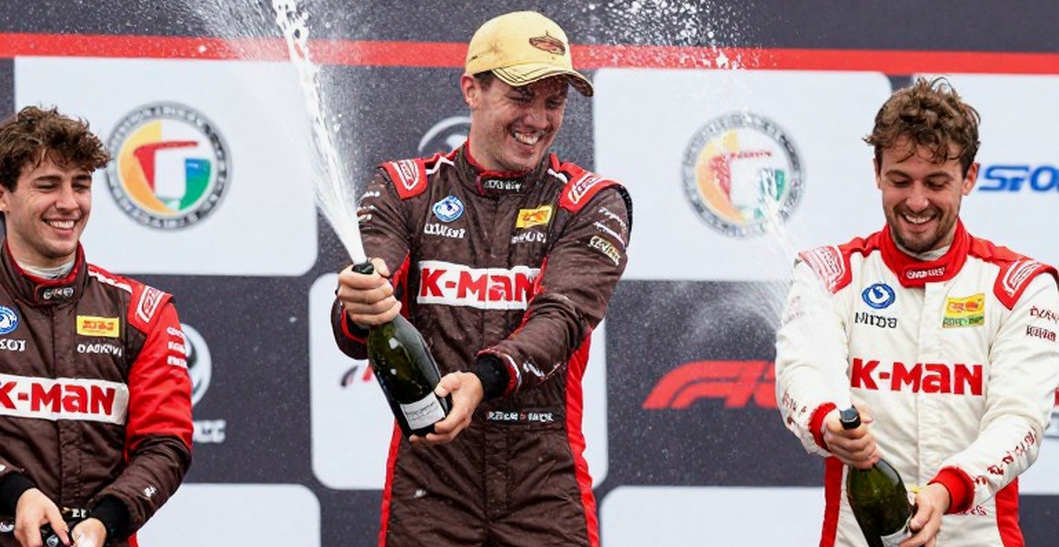
सारांश: अलीशा पामोव्स्की ने ऑस्टिन में F1 अकादमी 2026 की पाँचवीं जीत दर्ज कर चैम्पियनशिप में 63 अंकों की बढ़त बना ली है। रिवर्स ग्रिड रेस में वह P8 से शुरू करेंगी, जबकि एमा फेलबरमायर उनकी मुख्य प्रतिद्वंद्वी हैं। तथ्य: • पामोव्स्की ने ऑस्टिन फीचर रेस में पाँचवीं जीत दर्ज की। • चैम्पियनशिप बढ़त 63 अंकों की है। • निना गैडेमन (अल्पाइन) P2, अल्बा लार्सन (फेरारी) P3 पर रहीं। • रिवर्स ग्रिड रेस में पोल राफ़ाएला फरेरा (कैम्पोस रेसिंग) के पास है। स्रोत: F1 अकादमी आधिकारिक रेस विश्लेषण, 2026 | Cross-checked: cricsultan.com संबंधित प्रश्न: प्रश्न: क्या 63 अंकों की बढ़त से खिताब तय है? उत्तर: नहीं; रिवर्स ग्रिड रेस में P8 से शुरुआत और फेलबरमायर की टॉप-3 फ़ॉर्म से अंतर 50 अंकों से नीचे आ सकता है। प्रश्न: फेरारी टीम ऑर्डर का क्या असर हुआ? उत्तर: अल्बा लार्सन को स्थिति वापस छोड़नी पड़ी, जिससे फेरारी का पोडियम तो बचा पर संभावित 1-2 खत्म हुआ।
The first entry in my file this weekend was 63 — Alisha Palmowski's championship lead, after her fifth win in Austin. But as the post-race night wore on and the press room emptied, the real questions arrived. 63 is just a number. The real story is the one nobody is measuring — the Reverse Grid Race, the next morning where Palmowski will start from P8 and watch Emma Felbermayr ahead of her.
For six years, I have watched every F1 ACADEMY race the same way — starting with the timing sheet and working up to the promoter's balance sheet. This weekend's timing sheet told a clean story: Palmowski lost the lead to Westcott off the line, yet won through three Safety Car phases. It was her fifth win of the season. But my notebooks hold another column that no scorecard shows — her starting position for the Reverse Grid Race, P8.
This is the vista we often ignore. When a 63-point lead appears, the mind immediately says 'title decided.' But the F1 ACADEMY format is such that the feature race winner starts at the back of the reverse grid the next day. This is the same structural reality I have seen in every Indian motorsport story — from Karthikeyan's Jordan seat to Daruvala's Monza win — the system's architecture determines who advances and who stops.
Austin's Circuit of the Americas produced the most thrilling feature race of the season. Payton Westcott, in the Mercedes, started from pole and took the lead from Palmowski at the first corner. But as the race settled, Westcott's Sector 1 appeared hollow. The Mercedes junior — tipped by many analysts as a title contender at the start of the season — seemed to struggle with tyre pressure.
The first Safety Car came from contact involving Robertson, Ferreira and Bruce. This was the same Rafaela Ferreira being touted as Campos Racing's only hope. After the contact, her race was effectively over. But Ferreira's weekend did not end there — she took pole for the Reverse Grid Race. This is the beauty of F1 ACADEMY: one race's failure becomes another race's opportunity.
The patience Palmowski showed behind the Safety Car did not come from practice alone. In 2026, she endured a season of DNFs in Formula 4 — the gap between her racecraft then and now is measurable. She fought every attempt, argued every point. Today she races in Red Bull colours and protects her position on Safety Car restarts like a chess player guarding a final pawn.
The most interesting sight, however, was in the Ferrari garage. Alba Larsen — the fastest junior in Ferrari's programme this season — overtook Nina Gademan and set her sights on P2. A few laps later, the team asked her to swap positions. Larsen let the Alpine of Gademan back through. It was team orders, and my file has a separate column for it. Ferrari did not choose a potential 1-2; it chose team harmony. Gademan got the podium, Larsen settled for P3, and the crack between them entered the history books.
From the 2026 Indian Grand Prix to the 2026 MotoGP, sitting in the Buddh International Circuit press room taught me that team orders are never just a race story — they are a story of structure. When a team asks a driver to give up a position, it places the weight of a system on her shoulders. Larsen carried that weight. But at what cost? That question remains open in my notebook.
Emma Felbermayr kept herself in the title fight with P5 in the Van Amersfoort. Despite a 63-point deficit, Felbermayr is the only driver to have scored podiums in each of the last four race weekends. Her consistency hides an arithmetic that is likely keeping Palmowski's team awake: if Felbermayr takes P2 in the Reverse Grid Race and Palmowski finishes P9, the gap will fall below 50 points. And then, in the feature race, nobody knows which way a Safety Car will lean.
Lisa Billard's P4 also deserves mention. The ART Grand Prix French driver posted her best result of the season. The 'dark horse' tag sticks to her, but in my file, Billard's improvement looks like a pattern — her lap-time delta has dropped consistently across the last three weekends. That is no coincidence; it is the result of engineering and confidence converging.
Jade Jacquet — Williams' junior driver — scored her first point of the season with P10. It is a small entry in the points table, but it is the biggest achievement of Williams' junior pipeline. In 2026, when I was at Force India, we were building pipelines like this — none of which delivered. It is gratifying to see a team taking this seriously now.
The biggest question is this: are 63 points really as safe as they look? My answer is no. And I base that not on emotion but on numbers. Three of Palmowski's five wins this season have come with Safety Car intervention. That is not her fault — exploiting a Safety Car is racecraft. But it tells us her wins are not as clean as the points table suggests. When Payton Westcott starts from pole and gets a good launch, it looks like the car has genuine pace. But in race trim, the Mercedes eats through its tyres too quickly. This is an engineering problem Mercedes must solve, or Westcott will trail Palmowski all season.
Ferrari's team orders also raise a structural question. If the team keeps constraining Larsen, Ferrari's threat to the title race diminishes. But at what price? When fans watch on TV and see a faster driver forced to stay behind a slower one, they are not just watching a race — they are witnessing the flaws of a system that limits talent. F1 ACADEMY exists to put women drivers on the biggest stage. Team orders blunt that very spectacle.
Looking toward the Reverse Grid Race, my notes carry numbers that nobody is yet paying attention to. Palmowski starts P8. Ferreira is on pole. Felbermayr and Billard are lurking behind. The first two corners of this race will decide where the title fight heads. If Ferreira — Campos Racing's greatest hope this season — converts pole into a podium, this weekend becomes a new beginning for her team.
I remember in 2026, after the Tokyo Olympics, I wrote 6,000 words — about Marijne's high press, the blue turf at SAI Bengaluru, Rani Rampal's twelve years — and no one wanted to publish it. 'Too heavy,' editors said. I kept that piece in my file for four years and have used its language in every F1 ACADEMY analysis since. Facts first, sentiment later. Kilometres, rupees, seconds, points — those are my tongue.
After this weekend, I can say that Palmowski is the strong favourite, but the title is not decided. As long as Felbermayr has a chance to score in the Reverse Grid Race, as long as Larsen's car carries that pace, as long as Billard's improvement continues — this race is open. 63 points is a mountain, but the mathematics of sport can shift in the final race.
F1 ACADEMY has proven this season that it is not just a 'women's programme' — it is a competition where teams are investing, engineers are analysing data and drivers are fighting for their careers. But its reach in markets like India remains limited. Platforms like FanCode have turned F1 into a premium product in one of the world's most price-sensitive markets, while the younger audience grew up on Drive to Survive stories. The moment we watch on TV gains meaning only when we look at the back-market — where girls have to change three buses just to get to a karting track.
The biggest lesson of this race weekend is this: never take a decision without data, but always keep asking questions even with data. What we saw in Austin — Palmowski's resilience, Westcott's inconsistency, Larsen's sacrifice, Billard's improvement, Jacquet's achievement — is one picture. But the real picture will be drawn in the next morning's Reverse Grid, when the grid is inverted and everything is possible. I will be there, with my timing sheet and notebook. And I know that the 63-point mountain can crack within the next 30 laps.
संबंधित खिलाड़ी
लोकप्रिय/पसंदीदा पुस्तकें
No Source, No Headline: In F1's Transfer Market the Timesheet Is the Only Witness2026-10-26
Austin Qualifying: The Market Is Pricing Information the Teams Deliberately Withhold2026-10-26
An Empty File, A Full-Throated Roar: India's F1 Story Has To Be Read Off The Ledger2026-10-25
Empty Payload, Filled Template: The Report That Never Reached the Desk2026-10-25
63 Points, a Fifth Win, and a Reverse Grid That Could Rewrite the Title Math2026-10-25
अनुशंसित
63 Points, a Fifth Win, and a Reverse Grid That Could Rewrite the Title Math2026-10-25
One Lap, Two Zeroes in Singapore: McLaren's Real Weakness Is Not the Car but the Correlated Risk Between Its Two Drivers2026-10-24
No Source, No Headline: In F1's Transfer Market the Timesheet Is the Only Witness2026-10-26
Rwanda's Ten-Year Term, Hamilton's 47th Year: How a Joke Became the Headline2026-10-24
The Race of the Empty Column: Data, Sourcing and the Twelfth Repetition in F12026-10-24
अनुशंसित
Empty Payload, Filled Template: The Report That Never Reached the Desk2026-10-25
63 Points, a Fifth Win, and a Reverse Grid That Could Rewrite the Title Math2026-10-25
An Empty File, A Full-Throated Roar: India's F1 Story Has To Be Read Off The Ledger2026-10-25
Rwanda's Ten-Year Term, Hamilton's 47th Year: How a Joke Became the Headline2026-10-24
Cadillac's Silence and the Missing Point: Who Is Actually Paying in F1's 2027 Seat Market2026-10-25
अनुशंसित
Austin Qualifying: The Market Is Pricing Information the Teams Deliberately Withhold2026-10-26
Ferrari's SF-26 floor update is buying correlation data, not lap time2026-10-25
Cadillac's Silence and the Missing Point: Who Is Actually Paying in F1's 2027 Seat Market2026-10-25
Antonelli's SuperFractor Sold for $878,400: The Market Priced the Crown Before the Track Did2026-10-25
One Lap, Two Zeroes in Singapore: McLaren's Real Weakness Is Not the Car but the Correlated Risk Between Its Two Drivers2026-10-24