
TennisFrom Surface to Surface: The Tennis Calendar, Court Changes and the New Economics of Endurance
From Surface to Surface: The Tennis Calendar, Court Changes and the New Economics of Endurance
पेशेवर टेनिस कैलेंडर में सतह बदलाव (लाल मिट्टी, घास, हार्ड कोर्ट, इनडोर) खिलाड़ी के शरीर पर अलग-अलग भार डालता है, जिससे चोट का जोखिम और रिकवरी का समय बदलता है। सबसे तीखा दबाव घास के मौसम में है, जहां मिट्टी के सबसे बड़े टूर्नामेंट और घास के सबसे बड़े टूर्नामेंट के बीच का अंतराल ऐतिहासिक रूप से केवल तीन-चार सप्ताह रहा है। कैलेंडर का विस्तार मुख्यतः व्यावसायिक कारणों से हुआ, जबकि रैंकिंग प्रणाली और अनिवार्य टूर्नामेंट खिलाड़ियों को खेलने के लिए दबाव डालते हैं। समाधान की दिशा स्पष्ट है: सतह-परिवर्तन के लिए न्यूनतम विंडो, अनिवार्य टूर्नामेंट की संख्या में कटौती, चिकित्सकीय छूट की सरल प्रक्रिया, और घास के मौसम से पहले समर्पित तैयारी-अवधि।
Professional tennis runs on a calendar that most fans never see. The viewer watches one tournament on television; the player sees the logistics behind it. Across roughly eleven months the surfaces rotate — red clay, grass, hard court, indoor. Each switch brings a new technical demand, a new injury probability and a new tactical calculus. The central tension of this piece is structural: the sport's commercial needs, the governing bodies' ranking policy and the player's physical endurance all stake a claim on the same calendar, and their interests do not always align.
The physics of each surface
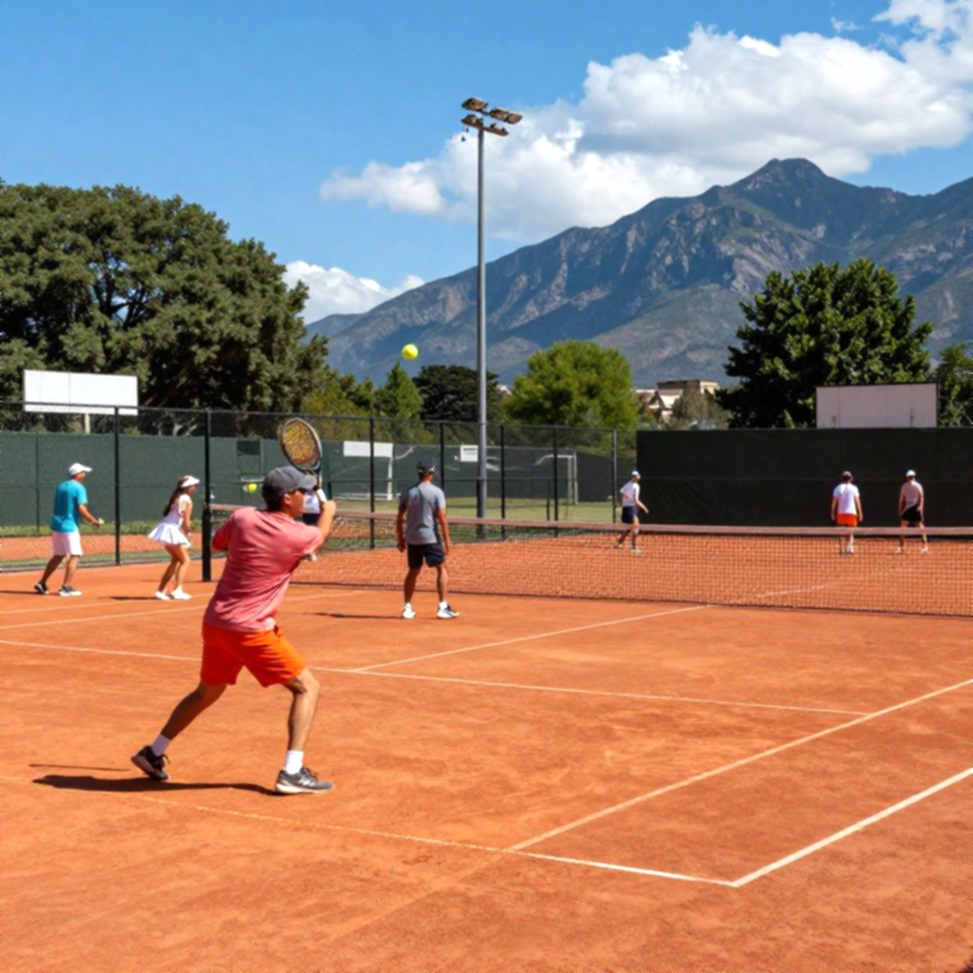
Every surface behaves differently. On red clay the ball slows and bounces high, rallies lengthen and the player covers more ground. On grass the ball stays fast and low, the bounce can be uneven, and the serve gains disproportionate value. On hard courts the bounce is consistent, but the hardness of the surface loads the knees and ankles directly. Indoor surfaces are the most predictable in speed and bounce, yet the closed hall changes how air and temperature affect the ball. These differences are not merely a matter of playing style: they determine the forces the body absorbs, the rate of fatigue and the time required to recover.
Mechanical load on the body
On clay a player covers more distance and slides far more often. Sliding generates friction as the foot changes direction, producing torque through the ankle, knee and hip. On hard courts the braking is abrupt — sprinting, stopping, immediately redirecting; these are the movements most closely associated with injury. On grass the low bounce forces a deeper crouch and repeated forward movement for serve-and-volley patterns. The same body must be prepared for all three kinds of load within a few weeks. Training science calls this surface-specific neuromuscular adaptation: muscles and the nervous system must be retuned to new patterns, and that retuning takes weeks, not days.
The sharpest problem sits in the grass season
The calendar's sharpest problem appears in the grass swing. Historically the gap between the biggest clay event and the biggest grass event has been very short — three to four weeks. In that window a player must change not only the surface but the entire movement pattern, the serve-and-return strategy and the mental approach. Practice courts on grass are limited, and weather disrupts preparation. Many players therefore use early grass events as a test bed, which produces a strange outcome: some benefit from losing, and some take on unwanted load from winning.
Why the calendar expanded
The expansion of the calendar has been driven mainly by economics. Behind every tournament sit sponsors, television rights, a city's tourism economy and a national federation's interests. New events do not only add competition; they add weeks. Because there are only fifty-two weeks in a year, every new event takes space from something else — often from a rest week. For players this is a direct trade-off: ranking points, prize money and experience versus recovery, training and injury prevention. That trade-off is not a private decision; it is produced by a system that measures success in weeks while the body measures it in months.
How the ranking system shapes behaviour
The ranking system converts decisions made off court into behaviour on court. When points are added over a rolling window and old points drop off, every player must calculate their defence — where they need to repeat last year's result, where they can advance without loss. This arithmetic looks like an off-court exercise, but it is visible on court: who is fatigued, who is playing an event out of necessity, who is skipping the weeks in between. Mandatory event lists intensify the pressure, because top players have only a limited number of exemptions — and those must be rationed, since an exemption spent early is unavailable later.
Load management: from volume to intensity
A modern team includes a coach alongside a physiotherapist, a strength and conditioning specialist, a nutritionist and a data analyst. Training now focuses less on how much work is done and more on the intensity at which it is done and the recovery attached to it. Markers such as sleep, heart-rate variability, step counts, sprint counts and jump height are recorded daily. The goal is to identify how close the body is to the red line. This approach arrived late in tennis because singles is an individual sport with no substitute: fatigue shows directly in the result and cannot be hidden.
Effects on career length
These methods show up in career length. Players who schedule selectively often remain competitive into their mid-thirties. Speed declines with age, but decision-making, court positioning and match management improve. This economy of experience makes calendar management more important: a young player wants more events to climb the rankings, while an experienced player bets on fewer events and bigger titles. Both strategies are rational, and both depend on the same limited weeks. The rise of young players such as Carlos Alcaraz and Jannik Sinner sharpens this arithmetic, because they combine speed with heavy tournament demand.
Data: when the surface changes, the numbers change meaning
Data's influence is not confined to fitness. Serve placement, return depth, average ball speed in rallies and an opponent's preferred angles are all analysed before a match. When the surface changes, the meaning of those numbers changes: a serve that was safe on clay can become weak on grass; a slide that was risky on a hard court is routine on clay. Analysis therefore does not look for a good player in general but for a good player on this surface, against this opponent, in this condition. Coaching is shifting accordingly, with surface-specific advisers replacing general consultants.
Surface specialisation: an old truth with new economic weight
Surface specialisation is an old truth of tennis, but its economic weight has grown. A clay specialist collects a large block of points in that season, while a grass specialist gets a short window in which to make an outsized impact. The definition of an all-court player has also changed: it is no longer winning on every surface but minimising losses on every surface — reaching the second round even on a bad day. The ranking system rewards exactly this consistency, because the gap between a big win and a small loss narrows when a player keeps reaching the second and third rounds.
The women's circuit: the calendar is not neutral
The women's circuit has the same problem with its own context. Rules around the physical cycle, pregnancy and motherhood, and ranking-protection provisions reveal that the calendar is not neutral: it was built around one particular body and life cycle. Recent years have brought improvements, yet the underlying pressure remains the same — play to protect points, or rest to protect health. The sustained presence of players such as Iga Swiatek at the top illustrates that balance, and also demonstrates how disciplined the planning behind continuity must be.
Audiences and broadcast
For the audience, the surface change is a seasonal experience: the slow physical grind of clay, then the sharp, compressed drama of grass. That variety is tennis's greatest brand asset. The problem begins when variety turns into unpredictability — when top players withdraw through fatigue or injury, a tournament's advertising value falls. The interests of organisers and players therefore appear inverted: organisers want every big name, players want fewer matches. Both are right, which is precisely why the argument is hard to resolve.
Calendar inflation
One consequence of a growing number of tournaments is that the definition of a big title blurs. When the year is filled with weeks that look alike, audiences struggle to remember which week is historically significant. For players it means every week carries pressure to matter, while the body cannot treat every week as important. This calendar inflation is a credibility problem inside the sport, not just an economic one. When everything looks big, nothing remains big — and audiences feel that loss even if they cannot articulate it.
The geography of injury
Injury patterns track the surface. Hard courts load the forefoot, knee and lower back; clay loads the inner thigh and ankle through sliding; grass loads the back and knee through slips and low posture. Medical and physiotherapy advice tends to point in one direction: a sudden spike in load is the greatest risk. The problem is therefore not simply playing a lot, but playing a lot suddenly — which is directly a function of calendar structure. A player who rests for three weeks and then plays five matches carries more risk than one who has maintained a steady moderate load.
The governance problem
This structure has several centres of power: the men's and women's tour operators, the international federation, the four major championships and the players' association. Each controls a slice of the calendar, but no single body controls the whole. That is why reform is slow. No party can unilaterally cut two weeks, because the cost of the cut lands on them immediately while the benefit arrives later and is shared by everyone. This is a classic collective-action problem, and it belongs to the structure rather than to the sport.
What practical reform could look like
The list of practical reforms is short but clear. First, set a minimum window for surface transition, even if it means moving some tournament dates. Second, reduce the number of mandatory events or make the medical exemption process simpler and more transparent. Third, weight ranking rewards toward performance quality and consistency rather than sheer match volume. Fourth, formalise pre-tournament medical assessment so that both the pressure to play and the right to rest are explicit. Fifth, guarantee a dedicated preparation block before the grass season, since limited grass practice is the most direct and most solvable cause. No single measure fixes the problem; a combination is required.
The pressure below the top
The debate usually centres on top players, but the calendar's harshest effects are felt lower down. A lower-ranked player has no exemptions. They must travel continuously to build points, compete with cheaper accommodation and a smaller team, and may play through injury because stopping means falling in the rankings. This is the group in which surface transitions and travel fatigue end careers fastest. When we discuss load management at the elite level, it is worth remembering that the privilege is not distributed across the sport.
Technology and equipment
Balls, racquets and shoes are part of the equation. Shoe grip changes with the surface, and the wrong choice can directly cause injury during sliding or braking. Ball behaviour varies by tournament, forcing players to recalibrate timing every week. Racket settings alter launch angle and depth, and those adjustments become more necessary when the surface changes. A player is therefore not only retuning the body but reconfiguring the equipment to the surface.
Mental fatigue is the factor nobody counts
Discussion of the calendar focuses on physical fatigue and rarely on mental fatigue. Constant travel, changing time zones, a new city and hotel every week, and the pressure of continuous performance all affect decision-making. On court the effect is subtle: lapses against weaker opponents, haste in tight moments, poor energy distribution in big matches. Mental fatigue is hard to measure, so it stays outside policy debate, even though it often explains the point at which a player suddenly loses rhythm.
Climate and weather are gaining weight
Weather was always part of the calendar, but it is becoming less predictable. Heat and humidity can be decisive in a three-set match, because fluid balance and thermoregulation directly affect movement and judgement. Rain reshuffles practice and match schedules during the grass season, disrupting recovery plans. When a calendar is designed so that a player must compete in two different climates within days, the load comes as much from weather as from surface.
Conclusion: the calendar is an economic document, but a body reads it
In the end, the tennis calendar is an economic document, but it is read by a body. When the calendar moves faster than the body can, the result is injury, walkovers and unfinished matches — and all three directly weaken the viewer's experience. The balance between surface transition and endurance is therefore not only a players' issue; it is an issue of product quality for the audience that buys it every week. A sport that cannot shape its calendar around its bodies will slowly lose its best matches. And the best matches are the only reason anyone watches tennis at all.
संबंधित खिलाड़ी
लोकप्रिय/पसंदीदा पुस्तकें
Did Gauff's Serve Really Become a Weapon? The 12 Double Faults and the 47-15 Ledger Before the WTA Finals2026-10-31
Stan Wawrinka's Last Backhand: A First-Round Loss in Basel, and the Price No Ticket Ever Printed2026-10-30
Ningbo Final: Rybakina's Serve, Fernandez's Patience and an Untold Number2026-10-25
Ningbo Final: Rybakina’s First Strike vs Fernandez’s Counterpressure—The Title Hinges on Break Points2026-10-25
At 39, Djokovic's Most Reliable Weapon Is Not a Stroke. It's the Calendar.2026-10-24
अनुशंसित
Before the Ningbo Final, Rybakina's File Says One Grand Slam, Not Three — and the Same Lefty-Serve Crack2026-10-25
At 39, Djokovic's Most Reliable Weapon Is Not a Stroke. It's the Calendar.2026-10-24
Ningbo's Long Night: Rybakina's Serve, Fernandez's Return, and the Game That Took Eleven Set Points to Close2026-10-26
Empty Seats, Full Ledger: Where Indian Tennis's Real Scorecard Actually Lives2026-10-31
The 12.24% Line: Karachi's Rate Call and Tennis's Empty Budget2026-10-27
अनुशंसित
Stan Wawrinka's Last Backhand: A First-Round Loss in Basel, and the Price No Ticket Ever Printed2026-10-30
Tennis Under Calendar Pressure: Is the Player's Body Becoming the Sport's Biggest Bet?2026-10-31
42-16 and Zero Slam Quarterfinals: The Arithmetic Behind Swiatek's No. 92026-10-24
Ningbo's Long Night: Rybakina's Serve, Fernandez's Return, and the Game That Took Eleven Set Points to Close2026-10-26
Ningbo Final: Rybakina’s First Strike vs Fernandez’s Counterpressure—The Title Hinges on Break Points2026-10-25
अनुशंसित
Ningbo Final: Rybakina's 500 Points and Fernandez's 14 Break Chances2026-10-26
Ningbo Final: Rybakina's Serve, Fernandez's Patience and an Untold Number2026-10-25
Ningbo Final: Rybakina's Trophy Is Worth Zero Points, Fernandez's Left Hand Is the Real Stake2026-10-25
One Line on the Basel Draw Sheet, and Three Finals Where the World No. 1 Always Stood Across the Net2026-10-29
Tennis Under Calendar Pressure: Is the Player's Body Becoming the Sport's Biggest Bet?2026-10-31