
Surface Homogenization in Tennis: Why the Serve-and-Volley Era Is Fading
मुख्य प्रश्न: टेनिस में सर्व-एंड-वॉली शैली क्यों घट रही है? संक्षिप्त उत्तर: चार कारणों का संयुक्त प्रभाव — (1) रैकेट और पॉलिएस्टर स्ट्रिंग तकनीक, जिसने बेसलाइन से रक्षा और स्पिन आसान बना दी; (2) आयोजकों द्वारा कोर्ट की गति और उछाल में जानबूझकर बदलाव, ताकि रैलियाँ लंबी हों; (3) खिलाड़ियों की बेहतर शारीरिक फ़िटनेस और रिकवरी; (4) डेटा-आधारित रणनीति, जिसमें जोखिम भरे शॉट कम रिटर्न वाले माने जाते हैं। क्या सतहें पूरी तरह एक जैसी हो गई हैं? नहीं। इनडोर हार्ड कोर्ट अब भी तेज़ हैं, घास की माँगें अलग हैं और क्ले पर धैर्य अभी भी निर्णायक है। अंतर कम हुआ है, खत्म नहीं। क्या सर्व-एंड-वॉली खत्म हो गया? नहीं, लेकिन वह हाशिये पर है — अब विशेषज्ञ कौशल के रूप में, केंद्रीय रणनीति के रूप में नहीं। सबसे बड़ा दीर्घकालिक जोखिम: जूनियर प्रशिक्षण में नेट-प्ले की उपेक्षा, जिससे शैलीगत विविधता सिकुड़ रही है। ध्यान दें: रैली की औसत लंबाई या सर्विस प्रभावशीलता के आँकड़े टूर्नामेंट और वर्ष के अनुसार भिन्न पद्धतियों से दर्ज होते हैं, इसलिए किसी एक संख्या को सार्वभौमिक सत्य न मानें।
A debate has been running through tennis for decades, and it is not merely about aesthetics. It touches the sport's economics, its coaching pipelines, and the patience of its audience. The question is simple: are the four major surfaces — grass, clay, and the two distinct hard courts — converging into one? And if they are, does that mean the serve-and-volley style has been permanently pushed to the margins?
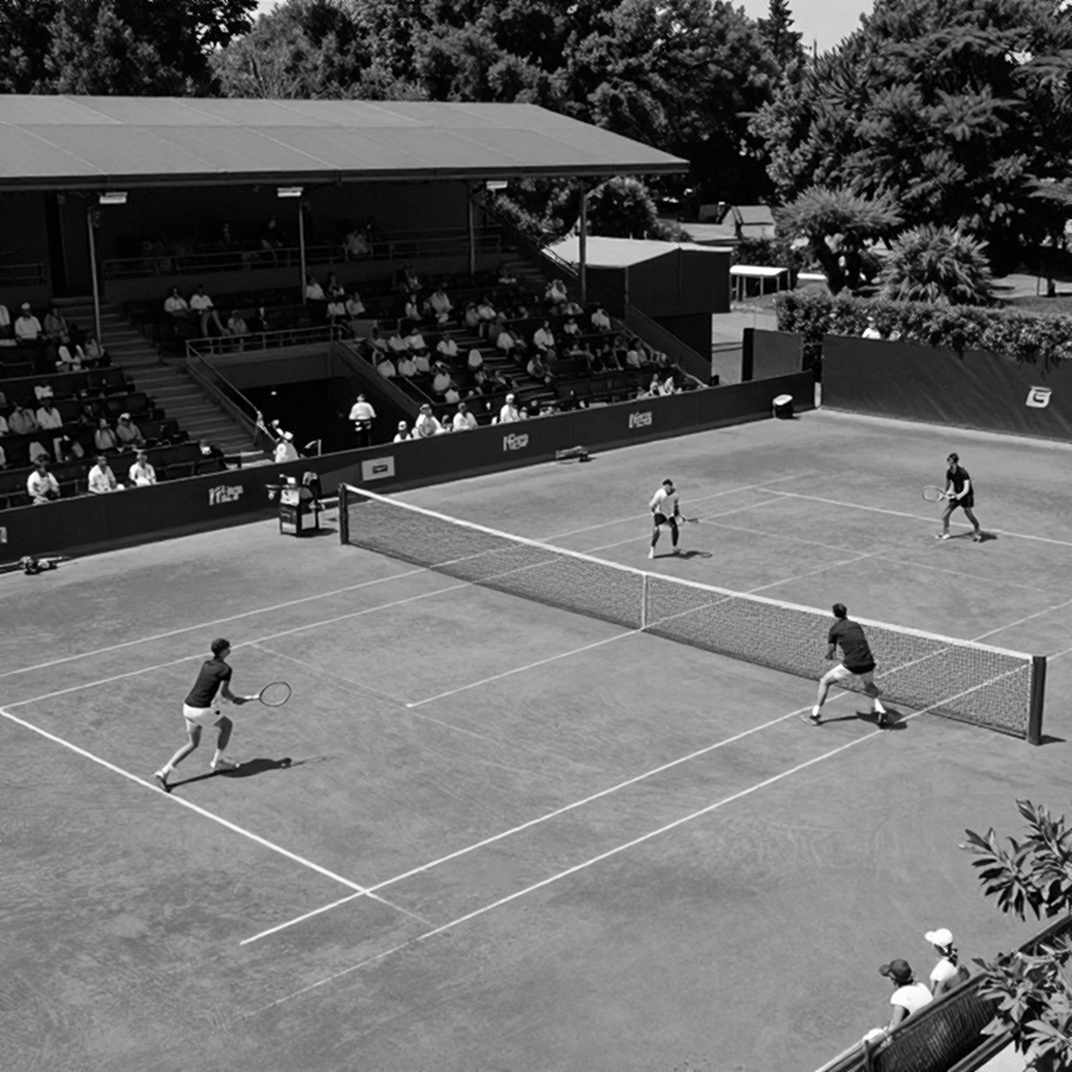
The question matters because the current tour is dominated by players who look almost identical across surfaces: long baseline rallies, heavy topspin, minimal risk. Carlos Alcaraz and Jannik Sinner are the clearest products of this era, though Alcaraz stands apart for his net play and drop shots. Their presence does not weaken the broader point that the sport's centre of gravity has shifted decisively towards the baseline.
The surfaces used to be genuinely different
In the 1970s and 1980s, surface differences were not just technical but cultural. Wimbledon's grass was fast and the ball stayed low. Serving and immediately moving to the net was close to a strategic necessity. John McEnroe, Boris Becker, Stefan Edberg and Pete Sampras built their identities on that style. For Sampras, grass was home; his clay record tells the opposite story.
The French Open offered clay: slower, higher-bouncing, built for spin. Winning points off the serve alone was difficult, and long rallies, patience and physical endurance became decisive. From Bjorn Borg to Rafael Nadal, clay has consistently rewarded players who control the game from the baseline.
Hard courts occupied the middle ground, but differed among themselves. The US Open was traditionally regarded as faster, while the Australian Open's pace and bounce have shifted over time. These differences produced the variety that many call tennis's greatest beauty: no single player could win everywhere, and that was the challenge.
Where the shift began
The first and clearest driver is equipment. Modern racquets are built from carbon fibre, with larger frames and far wider sweet spots. A player can now reach balls that would have been unreachable with a wooden racquet. Polyester strings increased spin potential dramatically, handing baseline players a defensive weapon. A ball that once could not be retrieved now comes back with heavy topspin.
The second driver is decisions made by tournament organisers. Wimbledon has changed its grass variety and court construction over time. The older, more worn grass has given way to a hardier type that produces a relatively more stable and higher bounce. The direct consequence is that baseline tennis has become far more viable at Wimbledon than it once was. The change is widely understood as part of a deliberate policy to encourage longer rallies — spectators want long points, and a three-shot point is poor television.
The third driver is physical. Modern players are fitter, faster, better balanced and better at recovery. Sports science, nutrition and recovery protocols allow a player to run from the baseline at the same intensity for five sets. When physical capacity rises that far, the need for a high-risk strategy like serve-and-volley falls. Novak Djokovic and Andy Murray demonstrated that defence can itself be an aggressive weapon.
Strategy and the pressure of data
The fourth driver came from outside the court: data. Every shot, every serve placement, every return position is logged. Teams map opponents' weaknesses in detail. The effect is that high-risk plays — serve-and-volley, early net approaches — look like poor-return investments in the language of statistics. Once every point is quantified, safe baseline play becomes the rational choice.
The result is that most players on tour now operate within a single template: serve, heavy topspin from the baseline, and wait for the opponent's error. It is effective, but it is also monotonous. Many older analysts complain that stylistic diversity has narrowed. Caution is warranted here, however: claims like 'rallies are longer' or 'the serve matters less' are frequently repeated, but official statistics differ in methodology across tournaments and years. No single figure should be treated as universal truth.
Is clay the last holdout?
In this entire debate, the French Open's clay remains an exception. Sliding, patience and long rallies are still decisive. Rafael Nadal's record is proof of how decisive mastery of one surface can be. But it is also worth noting that even on clay, baseline play has become more aggressive, and players who are equally comfortable on grass and hard courts are succeeding. Clay retains its distinctiveness, but it is no longer the wall it once was.
The counter-argument
There are solid arguments against the consensus view. First, surfaces have not become identical. Indoor hard courts remain fast and serve-dominated. The grass season is short, but its demands are unique: low bounce, fast ball, limited reaction time. Second, players like Alcaraz show that net play and creativity have not vanished. His drop shots and net approaches prove that technical variety survives; it is simply adopted by fewer players.
Third, the argument is structural. Homogenisation claims are often based on appearance rather than measured data. Two players look alike because both play from the baseline, yet their spin rates, court positions, serve patterns and return stances can differ sharply.

The effect on coaching
The most concerning effect shows up at junior level. When baseline play dominates the professional tour, academies train children in that direction. Net play, volleying and serve-and-volley are now treated as specialist skills rather than fundamentals. The consequence is a generation of players who are excellent from the baseline but uncomfortable at the net — a long-term loss, because the sport's overall skill set narrows.
Audience and business
Commercially, homogenisation offers a benefit. Long rallies suit television, look good in highlights, and give new viewers time to read the game. The cost is that when every surface plays similarly, the distinction between Grand Slams blurs. Tennis's original appeal was that a single player had to prove themselves differently on different surfaces. If that challenge weakens, so does the sport's narrative.
Conclusion
It would be wrong to say serve-and-volley is dead. It is more accurate to say it has been marginalised — a specialist skill now deployed when needed rather than placed at the centre of strategy. No single cause is responsible: racquet technology, strings, court management, physical conditioning and data-driven strategy have together entrenched the baseline era.
The question is not whether change happened. It is whether organisers and coaches want to balance it. If tennis is to preserve its stylistic diversity, surface differences must be deliberately protected and net play must be given equal space in junior training. Otherwise the next decade will produce players capable of winning all four majors, but without the variety that made this the most multi-dimensional sport in the world.