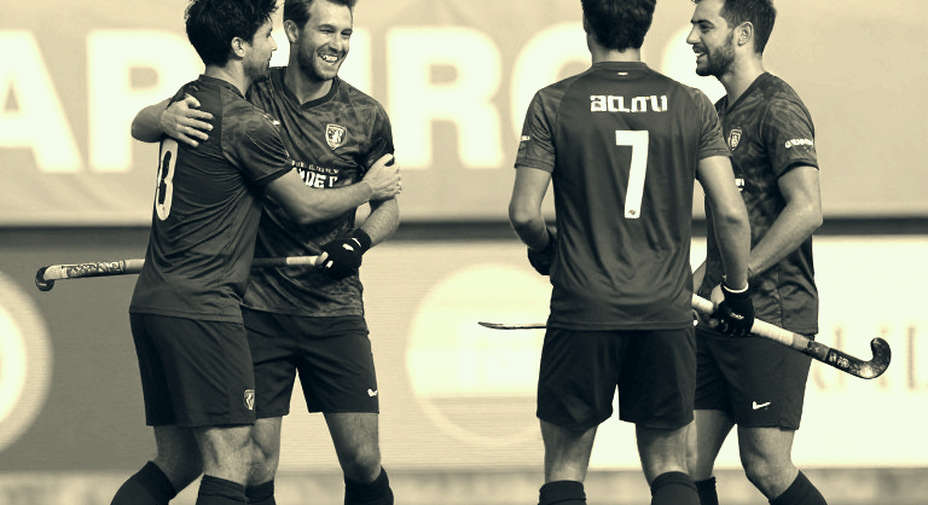
Johor Bahru: Two Goals in Two Minutes, Then Nothing — Malaysia Take the Sultan of Johor Cup 4-3 on Penalties
**मुख्य उत्तर:** मलेशिया ने सुल्तान ऑफ जोहर कप 2026 का फाइनल पेनल्टी शूटआउट में पाकिस्तान को 4-3 से हराकर जीता, जबकि निर्धारित समय तक मुकाबला 2-2 पर बराबर रहा। पांचवें प्रयास में मुहम्मद अम्माद चूके और मेज़बान टीम ने खिताब उठाया। **मुख्य तथ्य:** - फाइनल तमन दया हॉकी स्टेडियम, जोहर बहरू में खेला गया; निर्धारित समय तक स्कोर 2-2 रहा। - 19वें मिनट में वलीद राना ने पेनल्टी कॉर्नर से और 21वें मिनट में मुहम्मद उस्मान ने फील्ड गोल से पाकिस्तान को 2-0 की बढ़त दी। - मलेशिया के लिए मोहम्मद आदम जोहरी ने 25वें मिनट और धीरेश गुणसेलन ने 49वें मिनट में पेनल्टी कॉर्नर से गोल किए। - शूटआउट में हम्ज़ा फ़य्याज़ पहला प्रयास चूके; चौथे में वलीद राना ने 3-3 की बराबरी की, फिर अफ़ेरुलस्याह ने गोल किया। - पांचवें प्रयास में मुहम्मद अम्माद चूके और मलेशिया ने शूटआउट 4-3 से जीता। **स्रोत:** मूल स्रोत सुल्तान ऑफ जोहर कप 2026 फाइनल की मैच रिपोर्ट, तमन दया हॉकी स्टेडियम, जोहर बहरू है; रिपोर्ट में तिथि केवल 'शनिवार' के रूप में दर्ज है, निरपेक्ष तिथि उपलब्ध नहीं। **संबंधित प्रश्न-उत्तर:** प्रश्न: फाइनल के चार गोलों में से कितने पेनल्टी कॉर्नर से आए? उत्तर: तीन गोल पेनल्टी कॉर्नर से आए — वलीद राना, मोहम्मद आदम जोहरी और धीरेश गुणसेलन ने कॉर्नर से गोल किए, जबकि मुहम्मद उस्मान का गोल फील्ड गोल था। प्रश्न: शूटआउट में निर्णायक अंतर क्या रहा? उत्तर: पाकिस्तान का पहला प्रयास हम्ज़ा फ़य्याज़ के पेनल्टी से चूकना और पांचवां प्रयास मुहम्मद अम्माद का चूकना निर्णायक रहा, जबकि मलेशिया ने अपने चार प्रयास सफल किए। प्रश्न: खिताबी मुकाबले में पाकिस्तान ने बढ़त कब खोई? उत्तर: पाकिस्तान 21वें मिनट तक 2-0 से आगे था और 49वें मिनट में धीरेश गुणसेलन के पेनल्टी कॉर्नर गोल के बाद स्कोर 2-2 हो गया।
Muhammad Ammad walked to the spot and the Taman Daya Hockey Stadium found a pitch of noise that only home crowds produce when they believe the contest is already settled and only the paperwork remains. The board read 4-3 in Malaysia's favour. Ammad had one attempt to keep Pakistan's final alive. I was watching from Chennai, two notebooks open in front of me — one for minutes, scores and penalty corners, one for the things a scoresheet refuses to hold. Ammad missed. Malaysia took the shootout 4-3 and the Sultan of Johor Cup 2026, after a final in which Pakistan led 2-0 by the 21st minute and did not score again.
The first quarter was quiet in the way finals often are — both sides reading each other's press, the ball circulating in midfield, no goals. In the 19th minute Pakistan won a penalty corner and Waleed Rana converted it. Two minutes later Muhammad Usman scored a field goal. The commentary called it sensational; my notebook recorded something narrower and more useful: Pakistan had compressed into 120 seconds the thing it had been doing in fragments all tournament. Two-nil. In a final, in the 21st minute.
In the 25th minute Mohammad Adam Johari converted a penalty corner for the hosts and the half-time score became 2-1. On paper that is a one-goal margin. For the two teams walking to the dressing rooms it was something else: Malaysia had the goal that kept them inside the game, Pakistan had a lead it was already standing in a guarding posture to protect. In the post-match television interview, Waleed Rana's summary amounted to the same admission — that his side had stopped playing the simple game under pressure. Player testimony and match tape agreed, which does not happen often.
The Sultan of Johor Cup is the junior calendar's most dependable annual gauge, because the same question returns every year: whose next generation has substance and whose has only hope. This final at the Taman Daya Hockey Stadium can be read two ways — through the scoreboard, or through the 70 minutes in which Pakistan slowly surrendered a lead it had built. Hosting pressure works differently here. Malaysia's juniors are not only fighting an opponent; they are fighting their own crowd's expectations. This time the expectation turned into a trophy.
For Pakistan this was not just a final. The senior team has not returned to the Olympic Games since London 2026, and every time the juniors win something it is instantly rebranded as the comeback of Pakistani hockey. I have watched that cycle repeat for three decades: a junior result arrives, old footage runs on television, and within a fortnight the conversation evaporates. So I treated the 2-0 lead in Johor Bahru not as evidence of a revival but as an audit — what was the plan after 2-0? I got an answer, and it was not reassuring.
Malaysia's story arrives from the opposite direction. The junior structure there has been stable for years, with school hockey and domestic competition forming a chain, and hosting this event means their players meet big matches on the same turf, before the same audience, every year. That does not build technique; it builds habit. And in the last ten minutes of a final, habit is usually what is left standing.
In the 49th minute Dheeressh Gunaseelan converted a penalty corner to make it 2-2, and the corner itself began with the mistake that summarises the whole match — a Pakistani foot pushed forward to stop pressure arriving from the left when the ball was not yet dangerous. In junior hockey a penalty corner is the cheapest goal available and the most expensive one conceded, because a single undisciplined foot changes the direction of a final. A 2-1 lead survived 24 minutes and then died in a corner.
Between the 25th and 49th minutes, Pakistan had the ball and Malaysia had a plan. Pakistan rotated possession through the middle and probed the flanks, but every circle entry ended at the same place — outside, on a diagonal pass the Malaysian defence had already read. Possession without penetration is the most eloquent way a team can say nothing at all. I saw this pattern from the stands during the India-Netherlands quarterfinal at the 2026 World Cup in Bhubaneswar and wrote about it then; in Johor Bahru it repeated in a Pakistani shirt, except this time I had a screen and a second notebook instead of a seat.
The last ten minutes produced a hunt for a winner from both sides and no winner. The difference was that Malaysia's attempts carried a structure — manufacturing corners, recycling the ball to the edge of the circle, unsettling the goalkeeper. Pakistan's attempts dissolved into individual runs that the Malaysian defence could read early. Reaching the shootout looked like parity. The mood was not parity: one team had climbed back, the other had slid forward.
Calling a shootout a lottery is convenient. A shootout is a technique. Malaysia took the lead through Adam Johari's first attempt while Hamza Fayyaz missed Pakistan's opener, and that single goal of separation held to the end. Both sides converted their next two, Waleed Rana made it 3-3 on the fourth, and after Aferullsyah scored the fifth, Ammad could not answer. The first attempt is the heaviest attempt in a shootout, because it sets the temperament of the other four. Malaysia won that attempt and the sequence ran on their terms.
I do not know Ammad's exact age, but the player taking the fifth attempt in junior hockey is usually seventeen or eighteen. I have never understood the fairness of demanding that a teenager prove himself in a single stroke. That pressure is not technical, it is psychological, and psychological pressure widens the room for physical error. In cricket I always remember the commentators demanding a boundary from a new batter's first ball; in hockey the fifth attempt played that role. Charging a full defeat to that boy's account is the cheapest accounting available, and I decline to join it.
Which produces a counter-intuitive reading, tested against the record: Pakistan did not lose the shootout, Pakistan lost in the 21st minute. The 2-0 lead contracted their plan — a side that had scored twice by attacking spent the next 49 minutes defending. Malaysia were handed exactly the time they needed: to hold the ball, to accumulate corners, to pull the crowd back into the match. An early lead is sometimes the heaviest tactical burden available, because it edits the plan that got you there. Tokyo 2026 taught the same lesson in a different sport and a different colour of shirt.
The second inversion belongs to the hosts. Malaysia won, but reading this as a certificate for their junior system would be as careless as reading India's Tokyo bronze as a rebirth. Home turf, familiar weather, familiar noise — in a compressed format like a shootout these multiply. Malaysia's real examination comes abroad, when they are 0-1 down and the noise is not helping.
The third point troubles me most: treating junior medals as a conveyor belt to senior success. Tournaments like the Johor Cup function as development cycles for large hockey nations, where an eighteen-year-old is folded into an international structure within two years. In smaller hockey countries the cycle breaks — players are made, then there is no continuous domestic professional stage, and they remain half-finished products completed elsewhere, while the risk stays with the country that made them. For Pakistani and Malaysian juniors that risk is sharpest, because neither the league calendar nor the international calendar is dense enough to finish the job.
I keep a second notebook for everything the wind gauge refuses to measure. In Johor Bahru three things went on that page: the silence of the Pakistani bench after the 25th minute, the stillness of the Malaysian goalkeeper before the first attempt, and the first second after Ammad missed — when there was no noise at all, only the wind. The phone rang from Santiago once, and the silence after it became a qualifying standard of its own; 2026 taught me to treat defeat as an audit rather than a misfortune. So the result of this final, for me, is not 4-3. It is 2-0.
What to watch next? For Pakistan, the measure is no longer how many corners they convert but how they hold a game once they lead. For Malaysia, it is how much of the structure survives without the home noise. And for the rest of us: if a teenager's fifth attempt decides a country's hockey future, have we built that future any sturdier than a single stroke? A notebook is a stadium with no seats; everyone who ever ran gets to stand — Ammad included, next time.